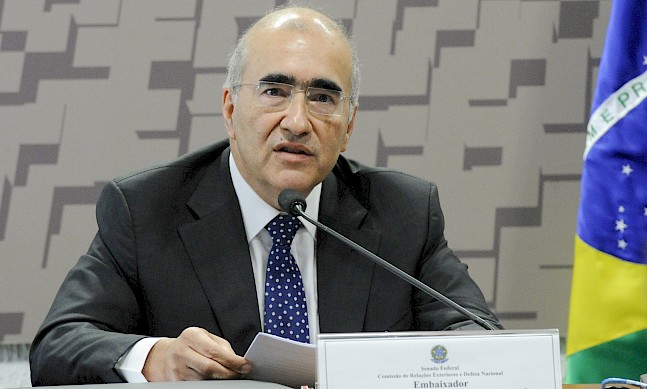








As Brazil and China deepen a relationship already defined by record bilateral trade – worth more than $171 billion in 2025 – attention is increasingly turning to the next phase of co-operation. Beyond commodities and commerce, the focus is now on industrial capacity, energy transition, infrastructure, agribusiness and long-term investor confidence. In this interview, Brazil’s Ambassador to China, Marcos Galvão, explains how Brazil is working to expand Chinese investment across key sectors while reinforcing its position as a strategic long-term partner.

Q: How do you see Brazil-China relations evolving?
H.E. Marcos Galvão, Ambassador: Both presidents have said that relations between Brazil and China are at the highest point they have reached since 1974. I think the figures show that this is not rhetoric, it is a fact. But we hope that this high point we have reached is not the ultimate culmination, but rather one point on a curve that continues to rise.
Trade is the most visible expression of this intensification of relations, but Chinese investment in Brazil is becoming an ever more important chapter of this relationship. These investments are also now experiencing a phenomenon of diversification. Previously they were very concentrated in the energy area, which, according to Industrial and Commercial Bank of China’s data, accounts for 75% of the stock of Chinese direct investment in Brazil. But investment is also now increasing in other areas, such as manufacturing.
The most visible outcome of these investments has been the opening of plants by Chinese companies producing electric and hybrid vehicles. There are also investments, for example, in the services area, which perhaps would have been less expected and intuitive. Companies in food delivery are making investments at this moment, for instance. So this is a relationship that is diversifying and multiplying but cannot do so without effort. Work is required because there is a great deal of complementarity between Brazil and China, but from our perspective, it still needs to be further stimulated and diversified.
Q: How is Brazil collaborating with China in industrialisation efforts?
MG: Part of our remit is to promote trade and Brazilian exports, but also to attract investment into Brazil. Neo-industrialisation is precisely where an important element comes in. China is seen by countries around the world as an industrial power with which it is very difficult to compete and, often, as a competitor. Indeed, it is a strong and highly competitive player. It is necessary to compete with China, and it is not easy for any economy in the world.
On the other hand, the Chinese have always had a very clear awareness that a country the size of China, and likewise a country the size of Brazil, cannot afford to give up having industry. So that makes our argument easier.
We are an open economy: we import products from all over the world, including from China, which is also our largest supplier in terms of imports. Almost 25% of Brazil’s imports come from China. But we always make it clear that it is not enough merely to sell to Brazil, or even simply assemble components in Brazil. We increasingly want growing portions of the production chains of the goods being offered, the goods entering the Brazilian market, to be produced in Brazil, and we also want research and development centres to be established in Brazil.
They understand this reasoning perfectly, because it is the reasoning that underpinned, and continues to underpin, China’s economic development. And as for the prefix “neo”, which requires reconciliation with sustainability, this is exactly what China is doing at this moment – investing heavily in the energy transition.
Q: What opportunities stand out in energy transition co-operation?
MG: The potential is immense, and it is more than potential: it is already a reality. China already has an important presence in Brazil in the electricity sector. According to the latest report on Chinese investment in Brazil, 45% of the stock of Chinese direct investment is in the electricity sector. China has a presence both in transmission and through investments in distribution and generation.
Clearly, this important presence indicates that Chinese companies in this sector and in others feel comfortable in Brazil. The Chinese presence in this area of the economy is a reality with very great potential, and I would say it is virtually certain that this presence will increase at a marked pace in the coming years. That is what is happening now. And Brazil is already the main overseas investment destination in the world for large Chinese companies in the electricity sector.
“Chinese companies see Brazil as an investment destination where they can operate, create positive synergies and obtain good returns.”Post This
Q: How are infrastructure synergies being developed with China?
MG: When President Xi visited Brazil in November 2024, the presidents agreed that we would establish a partnership and work to develop synergies between China’s development programmes, including the Belt and Road Initiative, and Brazil’s development programmes, including the new Growth Acceleration Programme and New Industry Brazil. That work is being done. It is co-ordinated by the Office of the Chief of Staff of the Presidency of the Republic, which is working with its Chinese counterparts precisely to identify projects that may become the object of additional Chinese investment in Brazil.
Q: How can agribusiness move beyond commodities exports?
MG: Brazil is one of the pillars of Chinese food security. The first pillar is Chinese agriculture itself, which is the largest agricultural sector in the world – but it is a sector that exports while its production is, above all, aimed at supplying the second largest population in the world. Brazil accounts for 25% of China’s global agricultural imports, at least 10 percentage points ahead of the second-placed supplier.
For China to have placed Brazil in this position as the leading supplier of agricultural products, there must be trust. One does not outsource a quarter of everything one buys from the world to a single partner if one does not trust that partner. And that is why I always draw attention here to the fact that the relationship between Brazil and China in this area is a relationship of trust.
Evidently, we cannot rest on our laurels. Reality is dynamic. It is necessary to work on our side and together with our Chinese partners so that we maintain a leading position in supplying agricultural products to China. This is already happening in Brazil, because Brazilian agriculture is a very dynamic sector, constantly renewing itself, increasingly attentive to sustainability and investing heavily in science and technology to increase productivity.
It is important that we make an effort both to make the sustainability of Brazilian agriculture stronger and more visible to the world, and to renew our industry and become capable of adding value to our agricultural products before they even leave Brazil.
Q: Which sectors now offer the greatest potential for Chinese investors?
MG: It is difficult to point to one specific sector. I think the very phenomenon of diversification of Chinese investment in Brazil, which basically stems from initiatives by Chinese companies seeking out opportunities, shows that Chinese companies see Brazil as an investment destination where they can operate, create positive synergies and obtain good returns. That includes in sectors we had not imagined they would enter so soon. This ranges from the automotive sector to the services sector – including investments, for example, that are taking place in coffee cultivation in Brazil, which until recently was a product little consumed in China, but which the younger generations are increasingly consuming.
Chinese companies are becoming increasingly present in sectors where we did not expect them to establish a presence. And that presence is growing at a speed that not even the most optimistic among us Brazilians would have imagined. The main drivers of this are the pursuit of opportunities and the complementarity that exists between our economies – but it is also the result of these economic actors’ perception that this is a favourable relationship.