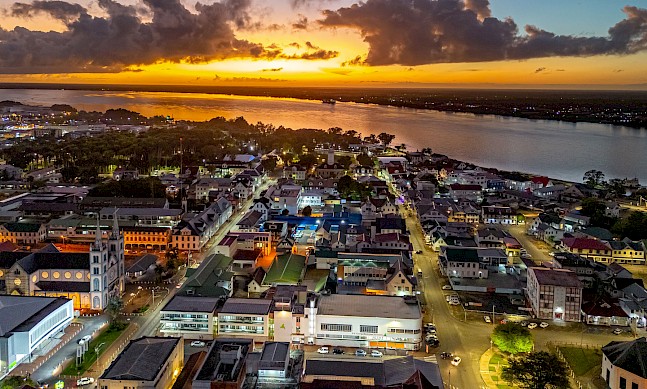









Suriname is emerging as a dynamic hub for investment, where vast natural resources intersect with pro-growth reforms. With opportunities in energy, agriculture, and infrastructure, the nation is positioning itself as a strategic gateway for U.S. investors.
Suriname is moving into a new phase of economic development—one defined by continuity, regional learning, and secured capital. For U.S. investors assessing the next frontier in the Americas, the country’s appeal lies not only in its offshore energy potential, but in the way it is sequencing growth: stabilizing first, planning carefully, and building frameworks before scale.
Recent years have been marked by necessary macroeconomic adjustment. Fiscal consolidation, debt restructuring, and reforms in public financial management have restored stability and credibility at a critical moment. Inflationary pressures have eased, transparency improved, and engagement with international financial institutions reinforced policy discipline. For long-term investors, these steps have signaled that Suriname is serious about predictability.
That foundation now coincides with a regional energy shift already underway in neighboring Guyana. The offshore oil boom there has reshaped investor perceptions of the Guyana–Suriname Basin, offering Suriname a rare advantage: the ability to learn from a neighbor’s experience in real time. Rather than rushing to first oil at any cost, Suriname has focused on regulatory sequencing. The country has worked diligently to clarify fiscal terms, strengthen institutional oversight, and align infrastructure planning with production timelines.
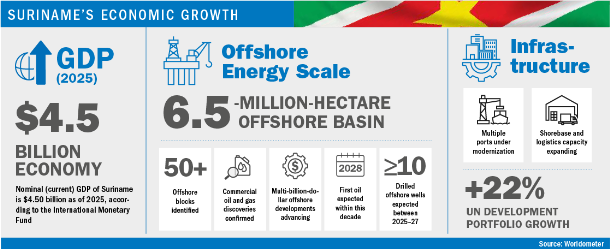
Major international operators are already ac-tive, and first offshore production is expected within this decade. For U.S. energy companies, service providers, and financiers, the opportu-nity extends beyond extraction. Local content frameworks, logistics, port services, data, envi-ronmental monitoring, and downstream services are all being positioned as part of a broader value chain. The emphasis is on long-term partnerships.
Crucially, energy is being treated as a catalyst, and economic diversification remains central to policy. Agriculture continues to provide employ-ment and export earnings, with scalable oppor-tunities in rice, fisheries, and agro-processing. Forestry, managed responsibly, supports both eco-nomic activity and sustainability commitments, while Suriname’s largely intact rainforest places it at the center of emerging carbon markets and climate finance discussions increasingly relevant to U.S. institutional investors.
Infrastructure investment is accelerating in parallel. Modernization of ports, transport corri-dors, and digital connectivity is improving access to regional and international markets. Suriname’s geographic position links South America, the Car-ibbean, and North Atlantic trade routes, and the country adds strategic relevance as U.S. compa-nies reassess supply chains, nearshoring options, and regional hubs. Public–private partnerships are playing a growing role in closing infrastruc-ture gaps that have historically constrained scale.
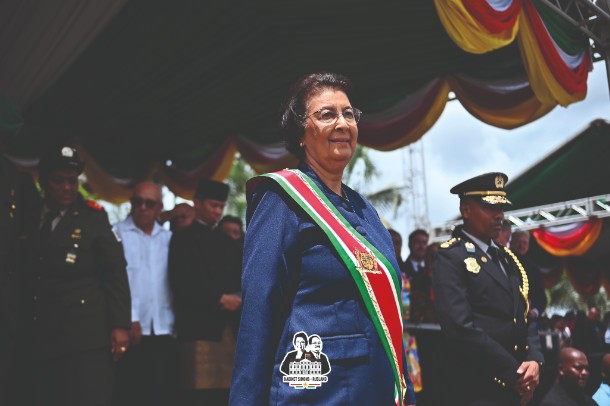
While Suriname’s democracy is vibrant and plural, economic policy direction has remained consistent. The recent election of the country’s first female president marked a historic transi-tion without disrupting reform trajectories—an important signal for investors weighing political risk over a multi-decade horizon.
Relations with the United States are deepening accordingly. Longstanding ties are increasingly complemented by commercial engagement, devel-opment cooperation, and private-sector interest. U.S. firms are active across energy, infrastructure, logistics, and services, drawn by Suriname’s im-proving regulatory environment, multilingual workforce, and openness to international partner-ship. For American companies, the country offers proximity, cultural familiarity, and alignment with rule-based business practices.
Suriname offers an increasingly rare opportunity: a small economy entering a growth phase with the benefit of regional experience, committed capital, and frameworks taking shape before scale.
Challenges remain. Managing expectations around future oil revenues, ensuring skills development keeps pace with investment, and translating macroeconomic gains into broader social outcomes will test institutions. But these challenges are now being addressed from a position of stability rather than uncertainty.
For U.S. investors looking beyond saturated markets, Suriname offers an increasingly rare opportunity: a small economy entering a growth phase with the benefit of regional experience, committed capital, and frameworks taking shape before scale. The momentum is real, and it is being built deliberately.

“We are sequencing our offshore development carefully by aligning fiscal rules, local content, and infrastructure before the first oil, not after.”
Andrew Baasaron Minister of Economic Affairs, Entrepreneurship, and Technological Innovation
Post This
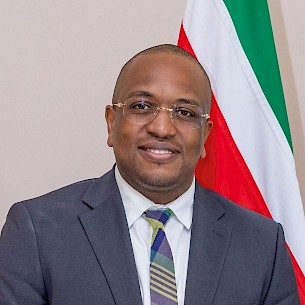
“Suriname’s location at the crossroads of South American and Caribbean markets provides a strategic advantage, positioning it as a resilient regional hub.”
Melvin Bouva Minister of Foreign Affairs, International Business, and International Cooperation
Post This

“As energy investment accelerates, we are modernizing ports, logistics, and digital infrastructure to connect Suriname more efficiently with North American and Caribbean markets.”
Raymond Landveld Minister of Transport, Communication, and Tourism
Post ThisFrom stabilization to momentum: a market regaining confidence
Suriname is steadily converting reform into measurable results. Fiscal stabilization under an IMF-supported program has strengthened macroeconomic discipline, improved transparency, and restored confidence among international partners. Inflation has been reduced significantly, public finances are under firmer control, and policy predictability has increased.
Flagship offshore developments, most notably the GranMorgu project, are progressing toward production and signal a new phase for Suriname’s energy sector. In parallel, targeted public and private investments in ports, transport corridors, and digital infrastructure are modernizing the business environment and reducing structural bottlenecks. Improvements in logistics, connectivity, and regulatory coordination are strengthening Suriname’s role as a gateway between the Caribbean and South America.
With clearer regulatory frameworks, renewed engagement with multilateral institutions, and growing interest from international investors, Suriname is positioning itself as a smaller but increasingly predictable market.