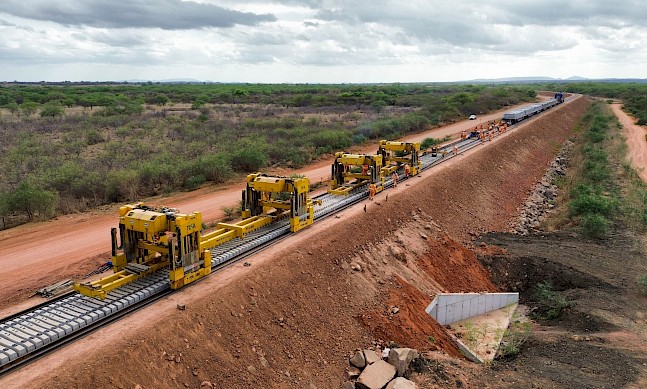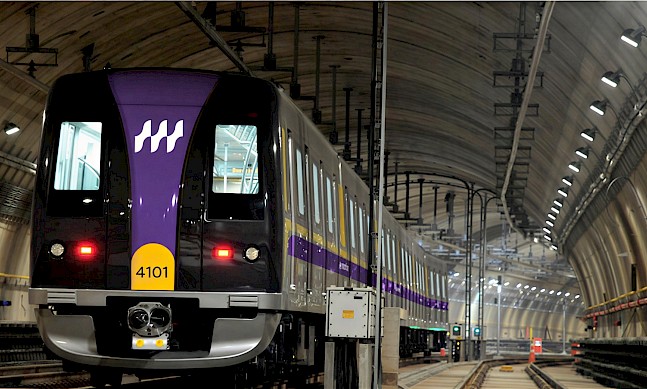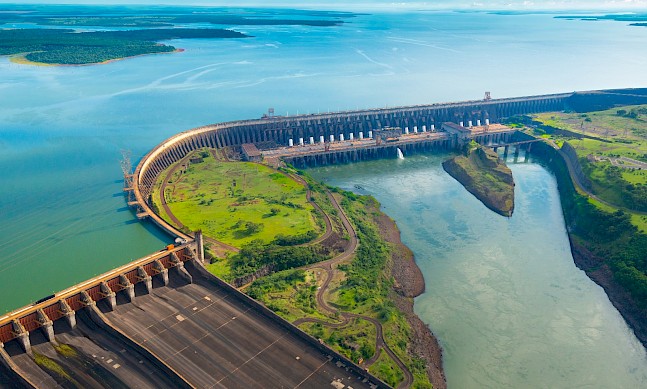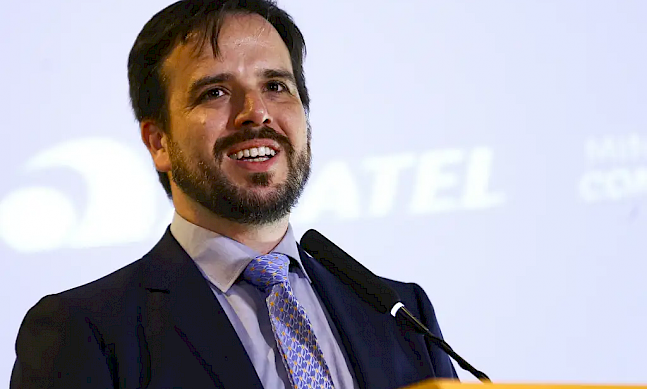








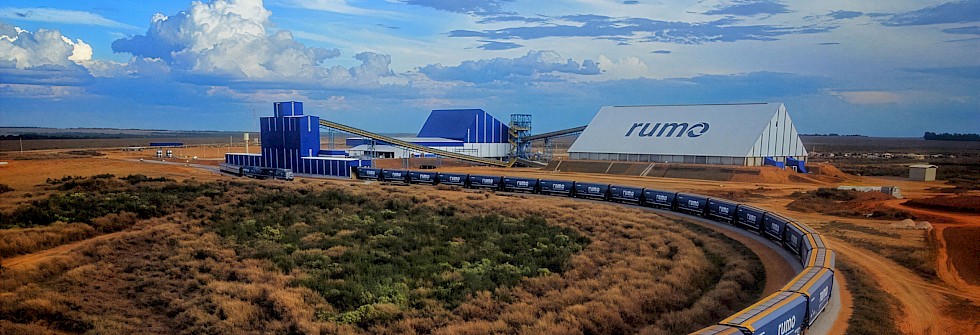
Part of the Cosan portfolio, Rumo is Brazil’s largest railway operator, managing around 15,000 kilometres of track that connect agricultural regions with export gateways. In this interview, Guilherme Penin, vice-president of Cosan, outlines the group’s investments in logistics, energy and sustainable growth.
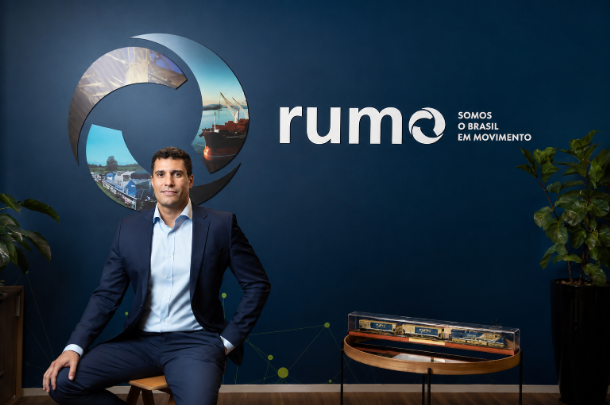
“Rumo has invested R$40 billion in railways over the last 10 years, basically across five projects.”
Guilherme Penin vice-president of Cosan
Post ThisQ: How is Cosan’s business portfolio currently structured?
Guilherme Penin, vice-president of Cosan: Cosan is the holding company. Essentially, there are five main business lines.
Let’s start with Rumo, which is the company Jorge Santoro is most closely connected to. It is the railway and logistics company. Rumo is Brazil’s largest railway concessionaire. It has roughly 15,000 kilometres of railway crossing nine states: Rio Grande do Sul, Santa Catarina, Paraná, São Paulo, Mato Grosso do Sul, Mato Grosso, Goiás, small parts of the Triângulo Mineiro region and so on.
A second business is Raízen. It is a company with two arms. One is the fuel distribution arm, which is the Shell service stations. The entire Shell brand in Brazil belongs to this company, Raízen. It has more than 7,000 service stations in Brazil, as well as bases, terminals and other assets associated with fuel transport. The other arm within Raízen is the sugar and ethanol arm. It has around 30 sugar and ethanol mills and is the world’s largest producer of sugar and ethanol.
Another line is gas. In gas, there is a holding company called Compass Gás e Energia, and beneath that holding company there are several businesses, all in the gas value chain. Then there is Moove, which is also a private company, in which we also own around 80%. That is the lubricants business, for both industry and cars and other vehicles. The fifth business is a land business called Radar, which is the least known. It is an agricultural real estate business. This company has around 340,000 hectares of land in Brazil.
Q: How does Cosan create opportunities for international investors?
GP: Cosan is a company whose businesses are largely connected to the country’s two main agendas: agriculture, especially export-oriented agriculture, and energy.
In agriculture, we are present both in production, through sugar and ethanol at Raízen, and in transport and logistics, through Rumo, which is the country’s major railway concessionaire.
In energy, we are present in fuels and biofuels, as the world’s largest ethanol producer, and in gas, which we see as a transition fuel. If you look at Brazil’s energy matrix, or rather Brazil’s electricity matrix, we often say it is very clean: 80% of Brazil’s electricity matrix is renewable. But if you look at Brazil’s overall energy matrix, only 50% is renewable.
There is a huge challenge for us to decarbonise our transport matrix and Cosan does that consistently through two levers. One is gas. When we replace diesel trucks with gas-powered trucks, when we replace industries powered by heavier fossil fuels with gas, we are decarbonising the planet. And when we replace truck logistics with railway logistics, we are doing the same. A train pollutes six to seven times less than a truck to carry a given volume over a given distance.
I think all these levers give us a relevant place in attracting capital, because we know that what the world basically needs today is good projects. I think we have several of them, connected to areas that simultaneously offer business returns — the agribusiness chains, the energy chains in a country such as Brazil — and are also connected to the planet’s needs from a sustainability point of view.
Q: What global potential does ethanol-hybrid technology offer?
GP: The ethanol hybrid is the most efficient solution that exists today from an emissions point of view. The ethanol hybrid car emits less than the electric car, in terms of grams of CO2 per kilometre driven. The best technological solution from an emissions point of view is the hybrid and ethanol model.
Ethanol itself is already an absolutely mastered and widely used solution in Brazil. All the car manufacturers from around the world that are installed here in Brazil manufacture ethanol cars in Brazil, and today it powers more than 90% of the country’s passenger vehicle fleet. It is a solution that is not only tested and proven, but widespread in the country.
The ethanol hybrid is one step further, because it is also a technological route that is already well known and mastered, and it can in fact be a powerful lever for decarbonising the planet.
Brazil should advocate more strongly for this as a country. It is difficult, but this is a mastered technology with an existing fleet and a truly renewable fuel. If you look at electric fleets around the world, there are many countries where electric fleets are already widespread, but which generate thermal power from coal. So, in fact, the ethanol car is genuinely a car powered by renewable energy, because it comes from the plant, from sunlight.
We often say here that sugarcane is the best way to convert solar energy into electrical energy, or kinetic energy, transport energy. It is the best possible converter. And that is what we do. It is truly 100% renewable energy.
Q: What has driven Rumo’s major railway investments?
GP: Rumo has invested R$40 billion in railways over the last 10 years, basically across five projects. One was the revitalisation of the old pre-existing railway network in the country, in which we invested several billion reais to update it.
The third project was the North-South Railway, an asset that had been under construction in Brazil for more than 30 years. Its construction began during the Sarney government in the 1980s, and then went through advances and setbacks. We acquired it in an auction, completed the work in a year and a half and have already put five terminals into operation on the North-South Railway.
So, in a very short period, there are already five operational terminals on this railway, and much more to come. Each one also has its own shareholder arrangement. There are terminals that are 100% ours, terminals that are 100% owned by the client or user who decided to enter a partnership with us to build a terminal and export its own cargo. There are terminals that are joint ventures, such as Alvorada with CHS, or São Simão with the Cargill team, or multipurpose terminals such as Rio Verde, which is a large terminal where clients or users sometimes establish themselves around the terminal to carry out activities connected to the railway.
This creates a huge number of opportunities across several links in the chain. Now we are carrying out the same process in Mato Grosso, as you mentioned. The railway reached Rondonópolis, in the south of Mato Grosso. The Rondonópolis terminal is the largest railway terminal in Latin America.
Q: Why is Mato Grosso central to Rumo’s expansion?
GP: This is a very large terminal that exports roughly one Panamax vessel of 80,000 tonnes of grain per day. It handles the movement and import of fertiliser from Santos to Mato Grosso to supply the farms in the interior of Mato Grosso. It handles fuel.
Then there is the export of corn ethanol. The same tank wagon that goes up with diesel and petrol returns with corn ethanol to the refinery, for blending at the refinery, for export or for consumption here in São Paulo.
If you look at Mato Grosso, which is the state that produces the most food in the world, it has the combined area of France and Germany. And it is not among the 20 Brazilian states with the largest railway networks. It has only 300 kilometres of railway. In other words, it is an immense state with very little railway.
Q: How does regulatory certainty strengthen infrastructure investment?
GP: I think Brazil has consolidated institutions in the infrastructure sector. I think the agencies work well. This applies not only to the agencies. I will even take the risk of saying that public policy formulation has had consistency over the years.
The infrastructure sector is essentially a long-term sector. Nobody builds a railway thinking they will make money in the short term. That does not exist in infrastructure. These are long-term projects, with decades of maturation, decades of capital contribution and sometimes construction, and so on, for you to be able to return the capital from projects like these.
So, it requires stability and consistency of decision-making and consistency of public policy. The formulation of public policy and the oversight bodies, among others, provide consistency in infrastructure policy over time, at least over recent decades, regardless of governments, for infrastructure policy.
That is a sign that foreign investors in general and Chinese investors in particular have believed in the country and made the investments Brazil needs in order to grow.
Q: Why should international investors choose Brazil now?
GP: I believe Brazil is a country with very relevant competitive advantages in some key sectors, such as agriculture and energy, and that offers important opportunities for investors. From the point of view of productivity in the soybean chain, the pulp chain, the corn chain and so on, Brazil is a country that offers many opportunities, as well as everything that is necessary to make this kind of investment viable, such as logistics, energy and so on.
In terms of technological routes, we sometimes undervalue our own country, but the truth is that the ethanol chain, for example, is something fantastic, as is the sugarcane ethanol chain. Brazilian technology has always involved partnerships, of course, but many important local initiatives have been decisive in enabling the productivity of Brazilian agribusiness itself.
The historic work that Embrapa has done over decades means that productivity per hectare in Brazil for products such as cotton, pulp and soybeans is incomparable with that found anywhere else in the world. I think that is where the countless opportunities our country has come from and what makes Brazil attractive to international investors.