








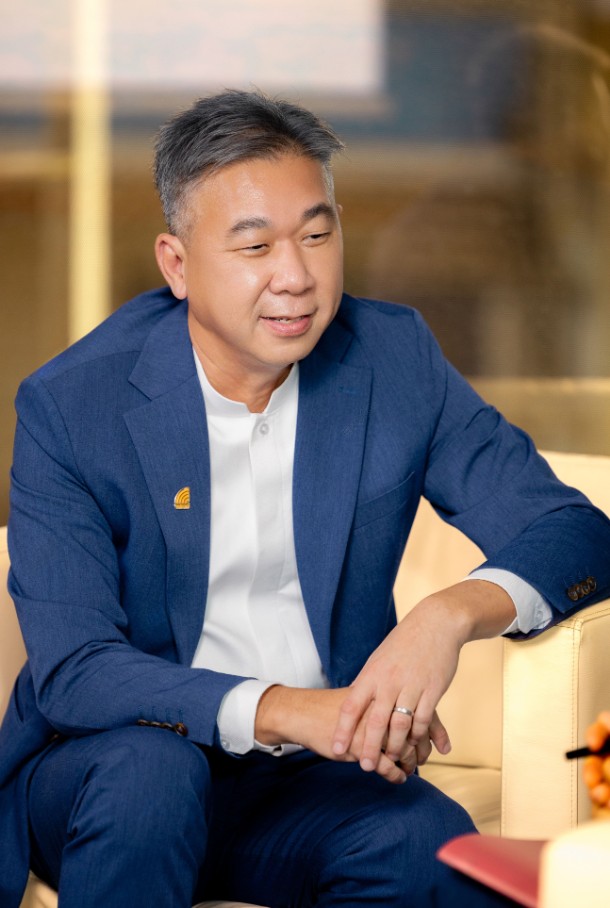
As a leading Cambodian telecommunications provider, cellcard is driving the nation’s shift toward a fully digital economy and shaping plans for next-generation services. With 5G officially launched in January 2026, CEO Yap Kok Leong discusses in this interview the success of Cambodia’s digital future.
“At home, customers have a strong internet connection, and outside, our mobile network complements it, creating a seamless connection.”Post This
Q: What is your vision for cellcard’s next phase?
Yap Kok Leong, CEO: Moving around the ASEAN region with a background in information technology and telecommunications, I have seen technology trends shift and people rapidly adopt new ones. This made me realize that the new cellcard we want to build must transform from a traditional telco into a digital ecosystem player.
This is a long-term plan, and we are now in the transition phase. Many traditional telcos are being disrupted by digital ones, which are born “digital-first,” meaning everything they do put digital at the center. We decided to bypass the old model and build ourselves as digital-first, using this transformation as a steppingstone toward becoming a platform telco in the future. That is our strategy now, and I believe the timing is right.
In Cambodia today, due to the COVID period and rapid adoption of online and mobile payments, this is the right moment to move into a digital telco model. Our team is now digital, and line-dot connected, meaning we want to connect people, the ecosystem they live in and the businesses around them. When you combine consumers and businesses, the value proposition for our customers becomes much greater.
This is our game plan, and we have already started this journey. If we execute it correctly, cellcard will become the foundation and center of Cambodia’s digital economy.
Q: How do you want investors to see cellcard?
YKL: This transformation is very crucial. When you look at Cambodia and ASEAN today, what they offer investors is one of the youngest populations in the world, and this population is digital-ready. That is very interesting, because in the digital world it is not just about the size of the population, but what percentage of that population is digitally ready.
In Cambodia today, people can pay with cash or by scan, and almost everyone is digitally savvy and mobile-first. Our job is to combine this and move them into digital-first. This will show investors that when they come into this market, cellcard can be a gateway for new businesses that want to tap into this young digital economy. We are ready to support them in accessing this group of people, helping them accelerate their business proposals and grow their business with us.
We believe in an inclusive strategy, building a digital ecosystem with telco as the backend. When investors or partners come, we bring them along as our partners to introduce value creation and value-added services to our consumers, who are all now connected.
We are not focusing on how many gigabytes or how much data we sell. We are focused on how to enrich people’s lives in the digital world. If there is a new solution or idea for digital life that investors want to adopt and bring to Cambodia, cellcard is the best platform because we connect the people for them.
Q: What defines cellcard’s market position today?
YKL: After 28 years in the market, we are now one of the largest industrial public-listed companies in Cambodia and we are 100% Cambodian-owned. That positioning is important because it tells investors that we understand Cambodia and its culture. When we serve customers, we bring years of experience interacting with them, understanding what they like and dislike, and communicating product messages clearly to the national market.
At the end of the day, you must always return to basics: how you interact and communicate with locals. As a local company, we understand them better. From a brand perspective, cellcard is already very trusted. When people think of cellcard, they know cellcard; awareness is almost 100%.
We are currently transforming and expanding our network to provide the best and most superior network experience. We have sister companies, Telcotech and Ezecom, and by combining our strengths we can provide convergent access both at home and on the go. At home, customers have a strong internet connection, and outside, our mobile network complements it, creating a seamless connection. This is how we can deliver digital-first services to all our consumers, which will differentiate us going forward.
Our next step is to expand beyond our current urban coverage into suburban areas to deliver seamless coverage. We are upgrading our technology over the next few years to provide a very good experience not only outdoors but also indoors, whether via Wi-Fi, 4G, or 5G penetrating directly into homes. That is our foundational strategy. As a basic telco, you cannot run away from the foundation: excellent internet access.
On top of this, we layer our deep understanding of Cambodian culture and our move into digital life. We will bring digital life to our customers, teaching them how to use internet access as part of their digital lifestyle and providing a distinct value proposition. In the future, we will not be talking about how many gigabytes you can buy; we will talk about how we can help connect your life. That is the message to our consumers today.
Q: How do cellcard, Ezecom and Telcotech work together?
YKL: Different countries have different regulations, and here the authorities ensure that service providers and infrastructure providers remain separate entities. The advantage of Royal Group is that we have both. We can provide the infrastructure that connects to your home, and we also have another company that provides services. Because these companies are part of the same family, we can ensure quality and deliver the same brand promise and customer experience.
Within the group, we have infrastructure, a tower company, an internet service provider and a mobile operator. We almost complete the full value chain. On top of that, we are building our enterprise business because we believe that serving customers only at home is not comprehensive. We must also deliver the same brand promise at work.
This completes the entire ecosystem: home, play and work, all with the same brand promise and quality assurance. This is very important when we speak to investors and visitors. Our aspiration is to be a Cambodian company that delivers world-class services across personal, home and work segments. That is a powerful proposition, and we position ourselves as the partner that helps investors and businesses access the young, digital-ready population and ecosystem.
“There are many new opportunities, especially in developing young talent that can grow in data monetization.”Post This
Q: How will you build on recent growth?
YKL: Like companies everywhere, Cambodian companies cannot escape the growth of data and artificial intelligence. These trends are becoming very strong. As data and AI tools become widely available, young people will leverage them to create more and more things. New growth will come from using the internet not only to consume content but also to create content and turn it into business monetization.
When that happens, demand for data will increase. Our role is not only to provide connectivity back to the digital world, but also to bring tools and partners. We work with global companies to help us bring powerful tools to help users monetize their activities on the internet.
In many countries, even when they have 95–100% internet access, most usage is still about consuming content such as videos. For Cambodia, the most important task is to transform that access into data monetization and improved skill sets. Data and AI create something amazing for Cambodia, because with AI access, everyone can now reach a much higher level of capability. It is no longer about how much you know, but whether you know what to do with what you know.
Cambodians are fast learners. They can access knowledge via data and AI and co-create something great from it. This is a tremendous opportunity for Cambodia and its people to move to the next level. We believe that if we help our consumers and our business customers monetize data through our network and services, they will stay with us and grow with us. That is the direction we are heading.
We are moving far away from the traditional telco model of selling gigabytes. Instead, we are focused on how to grow with our customers and help them succeed in the new digital life. This is not my first time in Cambodia, and I know the people. They are hungry to grow and fast learners. Cambodia is a peaceful and stable country, and stability allows people to grow. That is exactly where Cambodia is today, with many young people eager to advance.
Q: Why should global investors consider Cambodia?
YKL: When people think about Cambodia, many first think of tourism and visiting Angkor Wat. That sector is important and can certainly help the country grow. However, more importantly, we should also think about creating a data and AI hub here. There are many new opportunities, especially in developing young talent that can grow in data monetization. Why not in this country?
If you look at many countries that produced great ideas, they are often small countries like Singapore. In a small country, the natural way forward is brainpower. Now, with AI, that brainpower can be amplified. I am sure Cambodian talent can collaborate with companies from the United States, learn together, grow and then go global.
Investors from the United States and Europe should look at how to capitalize on a young, digital-ready, digital-native population with access to AI. In fact, we recently launched a new product called AOAI. Children can use it to help with their homework, so they are already using AI from school onwards. Imagine that: Cambodia, which many may not yet view as a highly developed country, is already adopting such tools.
If investors create opportunities to set up hubs here, collaborate, develop solutions and leverage the internet’s global reach, we can serve the world from Cambodia. This is a stable and peaceful country with people who are eager to work and inclusive in nature.
Cambodia has a population of about 17 million, with roughly 10 million being a solid digital-ready base. If all these 10 million people are fully connected through digital payments, digital ecosystems and mobile services, it becomes very easy to use Cambodia as a hub to showcase and test new ideas. If something succeeds with a 10-million population, it becomes much easier to replicate in larger countries for further monetization.
Cambodia can be this showcase hub, and cellcard, with all our facilities, is ready to support and collaborate with partners from the United States and around the world.
Q: How have past roles shaped your leadership style?
YKL: When we are young, we are very eager to work fast. Over time, as I gained experience running businesses in different places, I realized that you must work very closely with people. You cannot run very fast alone; you have to move together with your team so that they grow with you.
To move cellcard or any company to the next level, the first priority is people transformation. If you get people transformation right, business transformation will follow, because people decide the processes and policies. Once people understand the direction, want to win and want to change for the better, things will change. They will shorten processes and adjust policies to make things better for customers. Everything starts from people’s mindset.
The most important lesson I have learned from all these roles is to focus on people and people transformation. Once that is in place, everything else starts to work. You will be able to compete better because your people, processes and policies are streamlined, allowing you to move at least five times faster than competitors, and innovation will emerge.
This does not happen overnight; it is a journey. You begin with people transformation and gradually it becomes contagious. Your leaders start to understand that they must take care of their people, grow them and give them opportunities to try new things. Then business transformation will naturally follow.