







Steel Pipe Industry of Indonesia is cementing its dominant position in the nation’s steel sector.
Family-owned PT Steel Pipe Industry of Indonesia (SPINDO) is a market leader with an operational legacy spanning more than 50 years. Specializing in pipes for infrastructure, the company supplies sectors including oil and gas, construction, mining, telecom, and automotive, supported by an extensive distribution network. “We have built warehouses across Indonesia to be closer to customers and deliver faster,” says Vice President Director Tedja Sukmana Hudianto. “We aim to have one warehouse in every major city.”
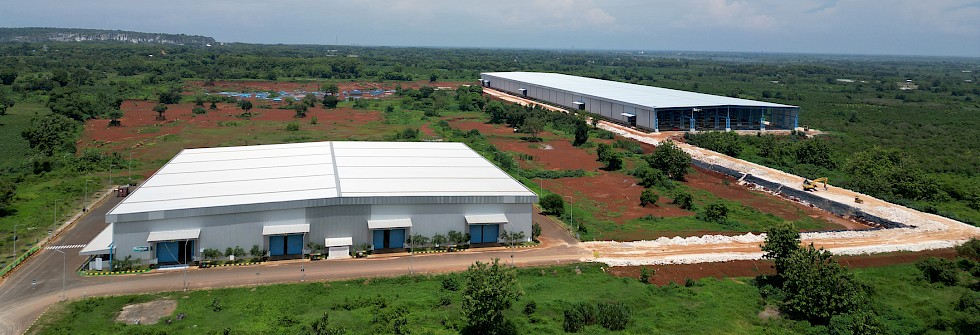
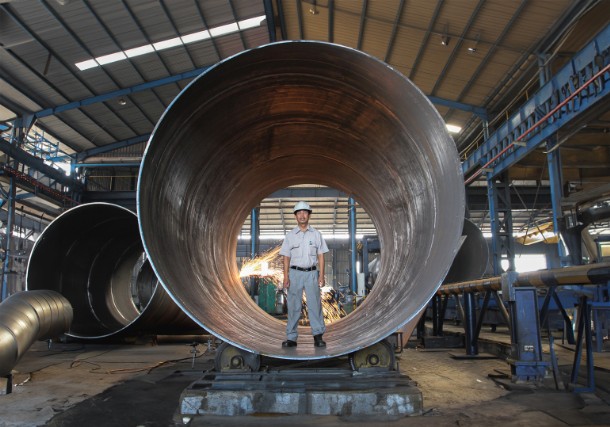
Complementing this is a commitment to innovation and cutting-edge technology that now sees the company completing its landmark Unit 7 facility – a 100-hectare site equipped with next-generation automation and production systems. The new unit will almost double production capacity and enable manufacture of larger-diameter, thicker-gauge pipes. “We are entering product categories that we could not serve before,” Hudianto says.
That positions the company to better service long-term export partners in the U.S. and Canada, while also benefiting from recent trade agreements. “With the arrival of our new machinery, our export potential will become significantly broader,” says Hudianto. In that context, SPINDO is seeking strategic partnerships founded on the principle of shared growth. “We are open to cooperating and growing together, but it must be a win-win,” says Hudianto. “Our hope is to attract investors who share that long-term perspective.”
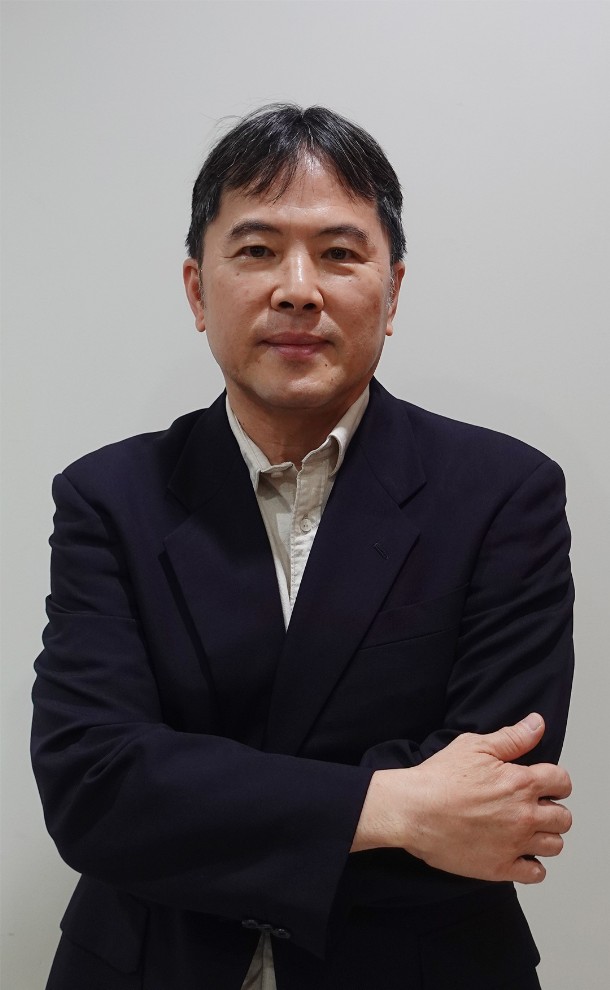
“The new unit will almost double production capacity.”
Edja Sukmana Hudianto Vice President Director
Post ThisRead below selected extracts from the interview.
Q: As SPINDO enters its next phase of growth, what operational priorities are guiding the company’s long-term investment decisions?
Tedja Sukmana Hudianto: To remain competitive, we must adopt new technology and follow current advancements. If we do not, and competitors do, we will lose. Technology is critical. Machine speeds are faster, electricity efficiency is better, and systems are becoming more digital. Coil weight has increased significantly, from 5 tons when we started to almost 35 tons today. If we cannot use 35-ton coils, we become less competitive. Smaller coils mean more joints and higher reject ratios; larger coils mean fewer joints and lower rejects. But this requires continuous investment.
Q: How do those priorities translate into changes across your production footprint and facilities?
TSH: Because machine speeds are faster, we also need larger facilities, bigger factories, not just bigger warehouses. That is why we purchased land for a new plant. We are developing Unit 7 on more than 100 hectares, redesigned with an ideal layout and full automation. We will reduce the number of workers, use small robots, and implement a manufacturing execution system so all data flows directly into the computer for quick analysis. This allows us to detect machine issues very quickly, which is essential for the future.
Q: What scale of capacity expansion does this new operating model ultimately support?
TSH: Overall capacity will be nearly double the current level, with larger diameters and thicker gauges. Previously, our straight-welded pipes were limited to 8 inches in diameter, with constraints on wall thickness. Now we can produce up to 20 inches with much thicker gauges. Essentially, we are entering product categories that we could not serve before.
Q: Which product categories become viable with this expansion?
TSH: Previously, our straight-welded pipes were limited to 8 inches in diameter, with constraints on wall thickness. Now we can produce up to 20 inches with much thicker gauges.
Q: How does this expansion align with Indonesia’s energy and infrastructure needs?
TSH: With these machines, we can provide greater support to the energy industry, particularly for oil and gas pipes, not only line pipes for distribution and transmission, but also pipes for drilling.
Q: How do you balance capacity growth with demand stability in the domestic market?
TSH: Our first priority is the national market. We do not want to lose domestic market share; we want to maintain and continue expanding it. We aim to have one warehouse in every major city. Indonesia has more than 37 provinces, so we still need to build 20–30 additional warehouses.
Q: Why has warehouse expansion become as strategic as factory investment?
TSH: We have built many warehouses across Indonesia, to be closer to customers and deliver faster, even in small quantities. Customers do not need to buy in large volumes; they can order daily or monthly. If customers prefer not to hold inventory, that is fine, we will take the inventory risk.
Q: How does this operational model protect margins amid price volatility?
TSH: Prices fluctuate because of China and our unstable currency. Customers can still secure their profits by buying at daily prices. Competing on price alone will not sustain us; we would not survive if we only fought on price.
Q: How does this expansion reshape the company's export potential and international market positioning?
TSH: With the arrival of our new machinery, our export potential will become significantly broader. If customers require these larger or thicker pipes, we can supply greater quantities. This positions us to benefit more from CEPA agreements and tariff advantages.
We never focus on currency. For industry, the most important factor is constant supply. Having a reliable and consistent supply is more important than currency fluctuations.
Q: How do you assess SPINDO’s current market valuation?
TSH: We are not very satisfied because the share price is still below book value. If investors understand our performance and what we are doing now, we hope they will become long-term partners, not just short-term participants.
We regularly hold investor gatherings, provide extensive information, and invite investors to our factory to see the production process. The situation is improving, our share price is more stable now, and things are getting better.