






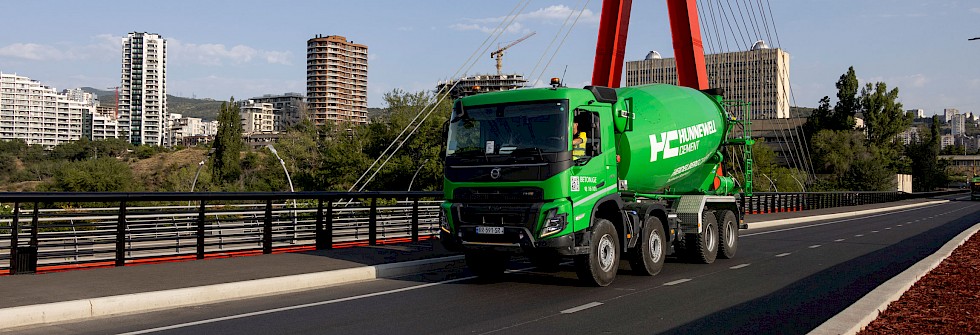
Hunnewell Cement occupies a key position in one of the region’s fastest-growing construction markets. Georgia’s only clinker producer, with roughly 60 percent of the market, the company operates an integrated network of cement, clinker and ready-mix concrete facilities supporting development on a national scale. “Our cement and concrete play an essential role across numerous projects, including residential developments, highways, bridges and strategic infrastructure that contribute to Georgia’s sustained economic progress,” explains General Director Davit Jughashvili.
The growth of the ready-mix segment reflects how closely Hunnewell’s development tracks that of the construction sector. Concrete has a 90-minute delivery window after mixing, meaning production facilities must be local to construction sites. As activity has spread beyond major cities, Hunnewell has responded to market demand. “We started with just two concrete batching plants,” says Jughashvili. “Today, we operate 16 plants across the country, and our expansion continues.” The company’s internal benchmark suggests plants become sustainable at roughly 20,000 cubic meters of annual demand—a threshold many regional markets are now reaching.
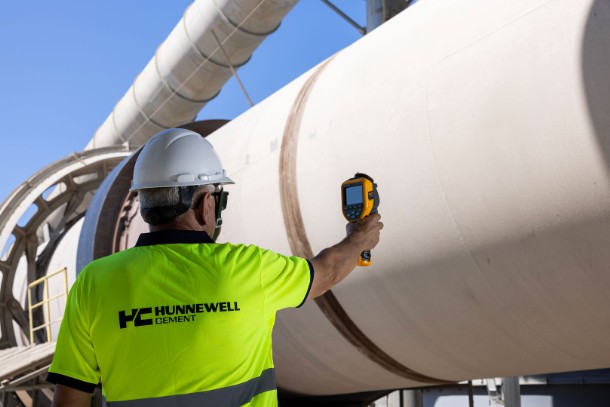
That expansion is backed by a $100 million investment program. At its center is a new state-of-the-art clinker kiln at Kaspi—the company’s existing production base—alongside two new cement mills serving eastern and western Georgia respectively and a continued expansion of the ready-mix network. “Our strategic objective is to scale our production to match the growth of Georgia’s economy,” says Jughashvili.
Georgia’s strategic location on the Middle Corridor is a key factor in its rising status as a trade and logistics hub. For Jughashvili, that will fuel continued infrastructure investment, particularly across ports, highways and rail. Combined with significant hydropower potential, it points to a construction pipeline that underpins Hunnewell’s role in national development. “Georgia is still in its early growth phase, and that is precisely why it is attractive,” he says.
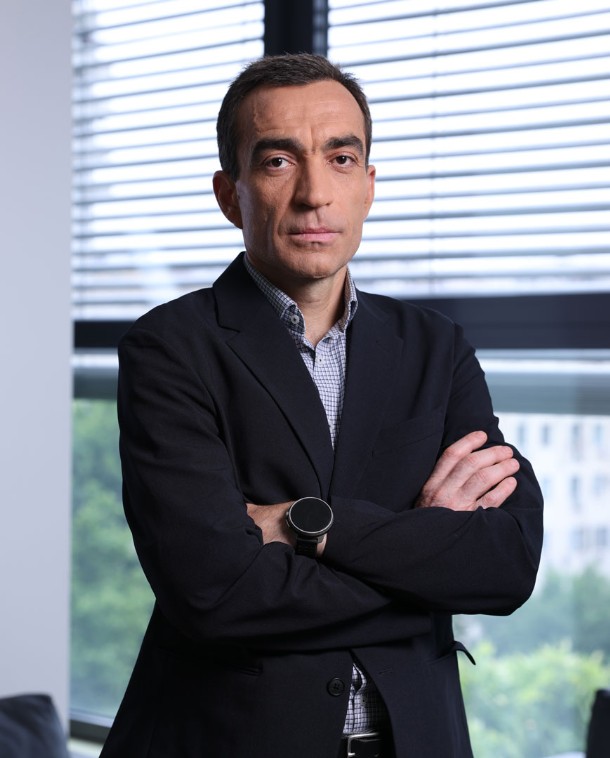
“We are the only clinker producer in Georgia, with roughly 60% market share.”
Davit Jughashvili General Director, Hunnewell Cement
Post ThisGeorgia’s cement and clinker market leader is investing over $100 million in growth. General Director Davit Jughashvili discusses regional expansion, new capacity and sustainable fuels.
Q: Could you begin by telling us about your professional background and how it shaped your leadership approach?
Davit Jughashvili, General Director, Hunnewell Cement: My professional journey began in the late 1990s, but I have been deeply involved in the building materials sector since 2008. At that time, Heidelberg Cement had recently entered the Georgian market through acquisitions of cement plants in Rustavi and Kaspi. My initial role was to develop the ready-mix concrete business together with German colleagues who had extensive experience across Europe. We started with just two concrete batching plants.
Today, we operate 16 plants across the country, and our expansion continues. The sector has evolved rapidly, and Georgia’s construction market is growing steadily alongside the broader economy.
Q: Why is the ready-mix concrete segment expanding so rapidly?
DJ: Concrete is a localized product. Unlike cement, it must be delivered within about 90 minutes after mixing, which means production facilities need to be close to construction sites. Globally, we see a clear shift: people are purchasing fewer bags of cement and increasingly using ready-mix concrete delivered directly from professional batching plants. This is more efficient, more reliable, and ensures consistent quality. In Georgia, per capita consumption of ready-mix concrete is rising as construction activity expands.
Q: Where do you see the biggest opportunities for growth in Georgia?
DJ: Historically, our production facilities were concentrated in major cities such as Tbilisi, Batumi, Kutaisi and Rustavi. However, we now see growing demand in mid-sized regional towns. Infrastructure projects and residential development are expanding beyond the capital, making it feasible to establish modern batching plants in these areas. Our internal benchmark suggests that a plant becomes sustainable at roughly 20,000 cubic meters of annual demand, and many regional markets are now reaching that threshold.
Q: You became General Director in August 2023. What were your main priorities when you assumed the role?
DJ: The timing coincided with a significant transition. Heidelberg Materials exited the company, and Georgian shareholders acquired their stake. Our priority was reassuring the market. Customers had relied on a global brand for nearly two decades, so we needed to demonstrate that the team, expertise, and quality standards remained unchanged. We focused on three pillars: maintaining the same level of product quality and operational standards, strengthening customer relationships and investing more aggressively in logistics, R&D and operational efficiency. The key message was simple: the company remains strong, stable and ready to grow further.
Q: How would you describe the company’s current position in the Georgian market?
DJ: We are the only clinker producer in Georgia, with roughly 60% market share in the cement sector. At the same time, about one million tons of clinker is imported annually, mainly from neighboring regions: Azerbaijan and Turkey, which means competition remains strong. Our goal is not only to maintain leadership but also to expand production capacity. In addition to manufacturing, our company creates thousands of jobs throughout the supply chain—from quarry operations and logistics to construction firms that depend on a steady supply of building materials.
Q: What are your major investment plans over the next few years?
DJ: We are preparing several major projects. These include: a new state-of-the-art clinker kiln in Kaspi; two new cement mills—one in eastern Georgia and another in western Georgia; and continued expansion of our ready-mix concrete network. In total, these investments will exceed $100 million. Once completed, they will allow us to fully meet the needs of Georgia’s rapidly expanding construction sector. Our cement and concrete play an essential role across numerous projects, including residential developments, highways, bridges and strategic infrastructure that contribute to Georgia’s sustained economic progress.
Q: Sustainability is increasingly central to heavy industry. How is your company addressing environmental challenges?
DJ: Sustainability is a top priority for us. Cement production naturally has a significant environmental footprint, so we are actively working to reduce emissions and improve efficiency.
Two important initiatives are already underway. First, alternative fuels. In 2024, we launched a system allowing us to use recycled tires as fuel in our clinker kiln. The extremely high temperatures ensure complete combustion, reducing landfill waste and lowering fossil fuel consumption. Second, refuse-derived fuels (RDF). We are preparing to integrate RDF produced from municipal waste as an additional alternative fuel for clinker production. This requires cooperation with government authorities and waste separation infrastructure, but it is an important step toward a circular economy.